
As the policy tide gradually recedes, the electric vehicle industry is facing a shift from “policy – driven support” to “market – driven self – sufficiency.”
In 2025, the penetration rate of new energy vehicles in China exceeded 50% for the first time. Behind this figure lies the real arrival of the era of “reverse cost between electric and gasoline vehicles.”
With charging piles spreading across the streets and alleys and the cruising range easily surpassing 500 kilometers, “range anxiety” is hardly a concern for car buyers anymore. The collective rise of domestic forces and the fierce internal competition have completely rewritten the rules of the game.
Behind the booming sales is the gradual improvement of “electrification,” which also means that the “intelligentization” competition has officially begun. Automobile manufacturers are hyping up the concept of “intelligentization” with endless gimmicks. However, when consumers actually get into the cars, they find that they still have to keep a close eye on the road during urban intelligent driving, and sudden braking and misjudgments by the system occur frequently.
Although technology is advancing, the user experience fails to keep up with the marketing pace.
A more crucial turning point came in 2026. With the halving of the purchase tax and the adjustment of subsidy policies, the electric vehicle industry is facing a shift from “policy – driven support” to “self – sufficiency.” In addition to the hard power of intelligent driving technology, the soft power of user experience should not be ignored.
In 2025, electric vehicles truly took the center stage.
The penetration rate of the new energy vehicle market in China exceeded the 50% mark for the first time. In November, it even reached 59.5%. That is to say, out of every 100 cars sold, nearly 60 were new energy vehicles.
Behind this “reverse cost between electric and gasoline vehicles,” on the one hand, is the improvement of the energy replenishment system. By the end of November 2025, the total number of electric vehicle charging infrastructure (chargers) in the country reached 19.322 million, a year – on – year increase of 52%. The number of battery – swapping stations exceeded 5,000 by the end of 2025, and the coverage rate of charging piles in highway service areas across the country exceeded 98%.
On the other hand, it is the continuous increase in cruising range. New energy vehicles generally have a cruising range of 500 to 700 kilometers, and some high – end models can even exceed 1,000 kilometers.
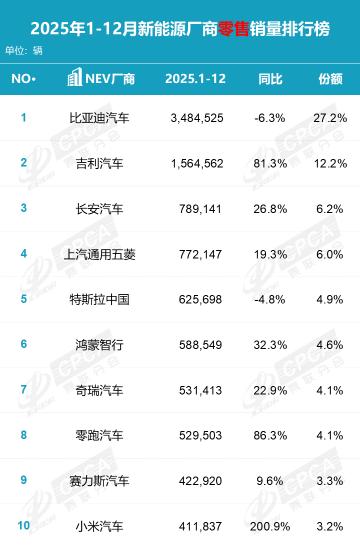
An even more profound change lies in the market landscape. In 2025, Tesla’s retail sales in the Chinese market declined by 4.8% year – on – year, to 625,900 vehicles. The era when Tesla dominated the electric vehicle market in China has come to an end. Instead, there has been a comprehensive rise of domestic forces and a fierce reshuffle of the internal rankings.
Currently, the domestic new energy vehicle market presents a situation of “one super – strong and multiple strong.” Among them, BYD is an unshakable super – leader.
According to the ranking of retail sales of new energy vehicle manufacturers from January to December 2025 released by the Passenger Car Association, BYD Auto ranked first with a cumulative sales volume of 3.4845 million vehicles. Although its sales volume declined by 6.3% year – on – year, its market share still reached 27.2%, making it the only automaker with sales exceeding 3 million vehicles.
The rankings outside the top spot were reshuffled in 2025. Some traditional automakers’ transformation efforts paid off, and they achieved rapid growth in the new energy vehicle segment. Geely Auto ranked second with 1.5646 million vehicles, a year – on – year surge of 81.3%, and its market share reached 12.2%, mainly driven by multiple new energy brands such as Geely Galaxy. Changan Automobile ranked third with 789,100 vehicles, a year – on – year increase of 26.8%.
Notably, there were many “dark horses” among the new – force brands. Leapmotor ranked eighth with 529,500 vehicles, a year – on – year surge of 86.3%, becoming the strongest dark horse among the new – force brands. Xiaomi Auto entered the sales ranking of new energy vehicle manufacturers for the first time with 411,800 vehicles, ranking tenth, a year – on – year surge of 200.9%. Brands like Li Auto, which were on the list in 2024, disappeared.
Image source: Passenger Car Association
Against the backdrop of the rapid iteration and intense competition within the domestic camp, brands that react slowly face huge pressure. Throughout 2025, Tesla basically had no new models in the Chinese market, and the novelty of the Model 3 and Model Y had worn off. In contrast, domestic brands such as Leapmotor launched multiple new models in 2025. XPeng’s MONA M03 and P7+ became best – sellers, and Xiaomi launched the YU7 after the success of the SU7.
These changes reveal a core fact: In 2025, the market witnessed not only the victory of electric vehicles over gasoline vehicles but also the profound impact of China’s industrial chain, the concept of rapid iteration, and the user – centered thinking on the traditional car – manufacturing model. Domestic brands began to take the lead in the market through more frequent new model launches, faster production capacity ramps, and more in – depth local innovation.
The fierce competition for market share also made 2025 a contradictory year with both “price wars” and “anti – intense competition” coexisting.
The price war triggered by Tesla’s official price cut at the beginning of the year lasted throughout the year. Many brands were forced to follow suit, sacrificing profit margins for sales volume. The transaction prices of some models repeatedly hit new lows. Under the intense competition, cost pressure was transmitted across the entire industrial chain. This also promoted “anti – intense competition” to become a consensus, and some automakers shortened the payment cycle to suppliers to 60 days to repair the ecological balance of the industrial chain.
More importantly, the fierce competition is driving industry differentiation. Some players are deeply trapped in the price – cut competition, while others are beginning to explore building moats through technology and ecosystem construction, laying the groundwork for a higher – level competition in the “post – subsidy era” in 2026.
The saying “Intelligentization is the second half of the electric vehicle era” was overused in 2025.
Since BYD declared 2025 as the “Year of Mass – market Intelligent Driving” at the beginning of the year, the intelligentization marketing campaigns have been non – stop throughout the year, with more and more eye – catching concepts and more and more spectacular press conferences.
BYD focuses on equal safety and technology dissemination, constructing the Tian Shen Zhi Yan technology matrix and announcing that all its models will be equipped with high – level intelligent driving systems. NIO pushed the first version of the NIO World Model (NWM) in 2025 and mass – produced and installed its self – developed 5nm intelligent driving chip “Shen Ji” in vehicles. Li Auto launched the VLA (Visual – Language – Action Model) driver large – scale model simultaneously when releasing the i8 in July, aiming to bring the “ChatGPT moment.” XPeng upgraded its corporate positioning to “Travel Explorer in the Physical AI World” at the Technology Day in November and released the world’s first mass – produced physical world large – scale model “Second – generation VLA.”
From a technical perspective, the VLM (Visual Language Model)/VLA was the cutting – edge focus in 2025. It attempts to supplement social rules and handle corner cases through large – language models, while the VLA model goes a step further, directly generating control based on understanding to make intelligent driving more human – like.
However, the VLA is essentially based on a linear mapping of vision – language – action. When dealing with some extreme scenarios, the generalization ability of the model still has limitations. Therefore, the world model has come into the sight of automakers. The core idea of the world model is to enable AI not only to learn “what to do when seeing something” but also to establish the ability to understand and predict the physical world, thus making more reasonable decisions.
At the same time, whether it is the “vertical integration” camp of full – stack self – development or the “open cooperation” camp of ecosystem – enabled development, automobile manufacturers are not only pursuing the evolution of intelligent driving technology but also promoting the construction of data closed – loop capabilities.
However, there is still a long way to go for intelligentization to evolve from technology to stable popularization.
The so – called “Year of L3” did not see substantial progress until the end of the year. The Ministry of Industry and Information Technology approved the access of two L3 models, the Changan Shenlan SL03 and the BAIC ARCFOX Alpha S, and their operation was limited to specific roads and speeds. Even so, the progress of L3 is still far from the L3 mass – production and on – road operation that many automakers promoted at the beginning of the year.
More importantly, the occurrence of several accidents during the crazy marketing of intelligent driving has greatly undermined consumers’ trust in intelligent driving.
Linda, a 30 – year – old white – collar worker in Beijing, replaced her car with a domestic electric vehicle equipped with the urban NOA function in 2025. She said that using intelligent driving on the highway is really worry – free and makes long – distance driving much easier. “But I’m not very brave to use it in the city. There have been several times when the system suddenly braked hard when a car cut in or suddenly changed lanes.”
This reflects the real situation of current intelligent driving technology: Its auxiliary value has been recognized, but there is still a considerable distance from real “autonomous driving” or a worry – free experience.
An observer in the electric vehicle industry commented: Automobile manufacturers’ current technological breakthroughs mainly focus on L2 – and L3 – level autonomous driving technology. However, the industry generally believes that the current situation is more like approaching L3 – level autonomous driving infinitely. Consumers do not have a clear understanding of the boundaries between L1 – to L3 – level autonomous driving technology and are more concerned about application scenarios such as automatic follow – up on the highway and urban driving.
Currently, manufacturers’ marketing tends to emphasize technological progress, while consumers’ attitudes have changed from the past desire for new experiences to the hope for a safer and better driving experience.
In 2026, the policy side dealt a heavy blow.
Since January 1st this year, the policy of full exemption of the purchase tax for new energy vehicles, which had been implemented for ten years, has officially switched to a half – exemption mode, with the tax rate adjusted to 5%. The maximum tax reduction per vehicle has been reduced from 30,000 yuan to 15,000 yuan. In other words, for an electric vehicle priced at more than 200,000 yuan, buying it this year will cost more than 10,000 yuan more than in 2025, equivalent to the price of a high – end laptop.
At the same time, the subsidy for trading in old cars for new ones has been adjusted, changing from a fixed – amount subsidy in 2025 to a proportional subsidy linked to the price of the new car.
The policy changes led to a wave of “last – chance” buying at the end of 2025. This also implies that the electric vehicle industry must shift from “policy – driven support” to “market – driven self – sufficiency.” With the penetration rate approaching 60%, the electric vehicle industry has passed the stage of relying on subsidies to get on track, and now it’s time for a “naked – swim competition.”
In addition to the hard power of technological iteration and cost control, the soft power of user experience should not be ignored. Among them, diversified energy replenishment methods are an important part of the soft power.
In 2025, ultra – fast charging and battery swapping evolved rapidly. In terms of ultra – fast charging, Huawei released a 1.5 – megawatt ultra – fast charging solution, which can charge 20 kilowatt – hours per minute and complete a full charge in 15 minutes. BYD launched its self – developed world’s first all – liquid – cooled megawatt flash – charging terminal system and plans to build more than 4,000 “flash – charging stations” in the future. ZEEKR’s V4 ultra – fast charging megawatt piles have been mass – produced and put into actual operation in the industry first. The 800V high – voltage platform and 5C ultra – fast charging are becoming mainstream configurations.
In terms of battery swapping, the competitive landscape has evolved from NIO’s dominance to a multi – party melee, accelerating implementation.
CATL has become one of the most important participants in the battery – swapping industry. In 2025, CATL’s Chocolate Battery Swap and Qiji Battery Swap built 1,020 and 305 battery – swapping stations respectively, exceeding their annual targets. In 2026, Chocolate Battery Swap plans to build more than 3,000 battery – swapping stations in more than 140 cities, start the construction of the highway network simultaneously, with a long – term goal of 30,000 stations, and will open a franchise program.
While NIO is deeply involved in the county – level market, it is also promoting the unification of technical standards and realizing the co – construction of a cross – brand ecosystem. Currently, NIO has built nearly 3,700 battery – swapping stations across the country. In addition, Aulton New Energy has submitted a prospectus to the Hong Kong Stock Exchange, aiming to become the “first battery – swapping stock” in Hong Kong.
In addition to the diversification of energy replenishment methods, the diversification of power forms is also a major highlight in 2026.
Different from the initial “pure – electric worship,” the current electric vehicle circle is a melee of extended – range, hybrid, and pure – electric vehicles. In 2026, not only new – force brands such as XPeng and Xiaomi are entering the extended – range vehicle segment, but also multinational automakers such as Ford, General Motors, Toyota, and Volkswagen are planning extended – range models. 2026 will see a wave of extended – range models from multinational automakers hitting the market.
Behind this is actually the result of market maturity and the differentiation of user needs. At the end of 2025, Zhang Yongwei, the chairman of the China Automobile Dealers Association, said, “Automobile consumption has entered a new stage. In the past, the goal was to ‘spend money to buy a car,’ but now consumers need to choose carefully to buy products that they truly recognize.”
The electric vehicle industry is entering a more practical stage, guided by real – world usage scenarios and product strength. This is also a transcendence of the “price war.” Enterprises need to more precisely identify niche markets and provide products and services that truly match the value.
At the same time, against the backdrop of intense domestic competition, going global has become a key direction for automakers in 2026.
2025 was a turning point year when electric vehicles comprehensively surpassed gasoline vehicles in terms of sales and perception. Entering 2026, the competition has entered a new track, which will be a comprehensive competition in terms of technological depth, cost – efficiency, ecosystem layout, brand value, and user loyalty. The real “naked – swim” has begun.
This article is from the WeChat official account “Bao Bian” (ID: baobiannews). Author: Nana, Editor: Xing Yun. Republished by 36Kr with permission.
该文观点仅代表作者本人,36氪平台仅提供信息存储空间服务。
36kr Europe (eu.36kr.com) delivers global business and markets news, data, analysis, and video to the world, dedicated to building value and providing business service for companies’ global expansion.
© 2024 36kr.com. All rights reserved.
Related Article