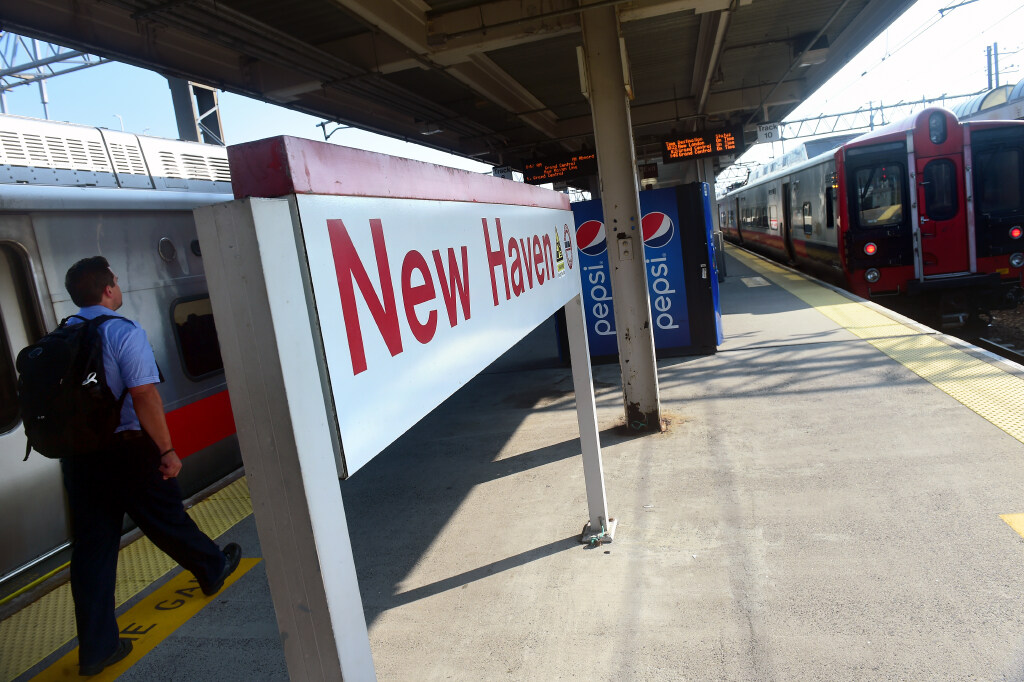
A sign for the New Haven stop on Metro-North’s New Haven Line. The new Metro-North cars will feature Wi-Fi service and power outlets, but they will not run on the main New Haven Line.
A representation of a new rail car is displayed in the parking lot next to Union Station in New Haven photographed on December 30, 2025. The new cars will feature Wi-Fi service and power outlets.
A model of a new rail car on display in the parking lot next to Union Station in New Haven showing digital displays photographed on December 30, 2025. The new cars will feature Wi-Fi service and power outlets.
A model of a new rail car on display in the parking lot next to Union Station in New Haven showing a larger bathroom photographed on December 30, 2025. The new cars will feature Wi-Fi service and power outlets.
State Department of Transportation Commissioner Garrett Eucalitto speaks alongside Catherine Rinaldi, then president of Metro-North, while touring an area of flood-damaged railroad tracks in Seymour, Conn., in August 2024. Rinaldi pushed Metro-North to improve cell service along the New Haven Line.
A new NextGen Acela train operated by Amtrak, which offers Wi-Fi to passengers.
In the East Lot outside Union Station in New Haven, what appears to be a trailer or small shipping container sits in one corner on top of several parking spaces.
Inside is a model of a new passenger coach expected to enter service in 2027. Two fact sheets lay out its features and amenities, including power outlets, laptop tables … and Wi-Fi.
Advertisement
Article continues below this ad
The state ordered 60 of the new train cars from manufacturer Alstom in 2023. After their delivery in late 2026, the coaches are expected to run on CTrail’s Hartford Line and the Danbury and Waterbury branches of Metro-North Railroad’s New Haven Line, replacing cars that are decades old. Details of how exactly the Wi-Fi would work were not immediately available.
But the new coaches won’t be coming to the main New Haven Line or its New Canaan branch, which use Kawasaki M8 cars. The fleet began to enter service in 2011 and now totals 471 cars.
For the foreseeable future, the only way passengers will be able to connect to the internet while traveling on the busy commuter line to and from New York will be through their cellphone data plans.
Advertisement
Article continues below this ad
Stephen Trudnak of Mansfield visits a model of a new rail car on display in the parking lot next to Union Station in New Haven on December 30, 2025. The new cars will feature Wi-Fi service and power outlets.
Rob Blanchard, Gov. Ned Lamont’s spokesman, said state Department of Transportation officials are “planning to have Wi-Fi on the new rail cars being procured, but after consultation with Metro-North, do not plan to install Wi-Fi on the M8s.”
“MNR’s input from riders made clear improved cellular service was a key priority, and we worked with the private sector to make that happen,” Blanchard said in a statement.
Advertisement
Article continues below this ad
In 2020, Lamont announced a partnership with AT&T to boost service on the New Haven Line and reduce dead spots. As part of the arrangement, officials gave AT&T access to the state’s right-of-way so it could place small cell nodes along the line. The telecom company has spent millions of dollars over the past several years to install nodes as well as new macro towers, providing a mix of 4G LTE and 5G service, according to a news release from spring 2025.
But according to a 2023 study of wireless connectivity on the New Haven Line, such an investment by a cellphone carrier will benefit only the passengers who use that carrier, while Wi-Fi would be available to all on board if it were installed.
A spokesperson for the Metropolitan Transportation Authority referred questions about the lack of Wi-Fi on the New Haven Line to Lamont’s office.
The governor’s office shared with CT Insider a copy of a 2024 letter from Catherine Rinaldi, Metro-North’s president at the time, to Connecticut Department of Transportation Commissioner Garrett Eucalitto laying out the railroad’s concerns about installing Wi-Fi on the New Haven Line’s trains.
Advertisement
Article continues below this ad
The costs would be “formidable,” Rinaldi wrote, “beginning with an initial up-front capital cost of approximately $39 million.”
A model of a new rail car on display in the parking lot next to Union Station in New Haven shows the new bike racks photographed on December 30, 2025. The new cars will feature Wi-Fi service and power outlets.
After 10 years, the hardware would need to be replaced at an estimated cost of $52 million, Rinaldi wrote, while “ongoing operating expenses” would cost about $3.7 million per year and grow to about $7 million over a decade.
And passing on some of the costs to customers wasn’t feasible, Rinaldi wrote.
Advertisement
Article continues below this ad
“Our customer surveys have shown that our customers have no interest in paying for Wi-Fi — 83% of our customers said they are unlikely to pay for this service — accordingly, our expectation is that these costs would be borne entirely by the transportation provider,” she wrote.
“None of these capital or operating expenditures are budgeted,” she added, “and they would necessarily divert scarce resources away from our core transportation mission, placing other service and infrastructure investments at risk.”
Back in 2010, MTA sought proposals for a private company to deploy Wi-Fi on Metro-North and the Long Island Rail Road, but it made clear the railroads weren’t willing to bear any of the costs.
In her 2024 letter, Rinaldi also raised concerns that Metro-North would need to take cars out of service for maintenance work on Wi-Fi equipment, as well as impacts to on-board safety systems and cybersecurity.
Advertisement
Article continues below this ad
A Metro-North Railroad train heading north stops at the Fairfield-Black Rock train station on August 5, 2025. The new Metro-North cars will feature Wi-Fi service and power outlets, but they will not run on the main New Haven Line.
She argued it was better to zero in on improving cell service, as has also been the approach for the LIRR.
“Over the past several years, New York MTA’s strategy for improving on-board connectivity has been to focus on improved cellular coverage along the right of way rather than installing Wi-Fi equipment on trains, and to look to cell carriers to bear the cost of any additional installations or upgrades,” Rinaldi wrote. “With the arrival of 5G, we are finding that most of our customers’ connectivity needs can be met through improved cellular coverage.”
Blanchard said Lamont “is continuing to work with CTDOT, its rail partners and the private sector to expand wireless connectivity for customers on the New Haven Line.”
Advertisement
Article continues below this ad
In 2022, Lamont and the state legislature set aside $23 million in federal COVID-19 recovery funding to “outfit M8 rail cars with 5G,” with the idea that a 5G-based Wi-Fi system could be developed in the future.
Blanchard said some of the $23 million paid for the wireless connectivity study, but the rest was reallocated to other uses when it became clear the state DOT couldn’t spend the money by a federal deadline.
As part of the 2023 study, AECOM Technical Services and STV performed a coverage survey that found poor signal quality, limited bandwidth and sometimes no service at all at points along the state’s rail network. The consultants looked at several ways officials could enhance connectivity on the New Haven Line, weighing the pros and cons of each approach.
Commuters board a Metro-North train to New York City in March 2025 at the Stamford Transportation Center in Stamford, Conn. The new Metro-North cars will feature Wi-Fi service and power outlets, but they will not run on the main New Haven Line.
The study said on-board Wi-Fi “would provide an immediate performance boost for all passengers,” regardless of which cellphone carrier they use.
Advertisement
Article continues below this ad
If passengers can access the internet only through a cellular data plan, their connectivity depends on the number of cell towers their carrier has in the area, how close the towers are to the railroad and how many people, including those not riding the train, are using the network, according to the study.
But a Wi-Fi system could “aggregate each carrier’s network into one single, higher-performing network that is better than any single provider can offer,” the study said. It also would allow laptop and tablet users to connect to the internet without having to use their phone as a hotspot.
The cost of the Wi-Fi equipment could “vary greatly depending on the quality of equipment desired,” the study noted.
Without Wi-Fi, the study said, the major carriers — AT&T, Verizon and T-Mobile — would all have to build additional towers near the railroad for every passenger to experience better performance.
Advertisement
Article continues below this ad
Forgoing Wi-Fi and working with cell carriers to add towers likely would be “the lowest cost and simplest option” for the state, the study said. But the carriers would need to make it a priority, obtain necessary permits and address any community concerns about the structures.
The “most expensive and complex” option would be installing both Wi-Fi and trackside infrastructure dedicated to train passengers, according to the study. Though costly, it would provide “the greatest enhancement to wireless connectivity,” with faster and more reliable service, plus a more secure network, the study said.
A map of the CT rail lines displayed in a model of a new rail car in the parking lot next to Union Station in New Haven photographed on December 30, 2025. The new cars will feature Wi-Fi service and power outlets.
As for satellite-based internet, the study said overhead obstructions such as tunnels, bridges and station canopies could interrupt the signal. Still, AECOM and STV said the state could try out the technology as part of a pilot program.
Advertisement
Article continues below this ad
The consultants recommended a two-phase approach to improving connectivity on the New Haven Line. The first would include a Wi-Fi system and the second would involve the installation of trackside infrastructure, “focusing on areas with the weakest signal quality or bandwidth to ‘fill in the gaps’ identified in the coverage survey.”
As part of the study, the consultants spoke with officials at Amtrak, which does offer what it describes as free “basic” Wi-Fi.
The study said Wi-Fi performance for Amtrak passengers can vary because of the way the system was set up on the railroad’s Amfleet trainsets: a “brain car,” usually the cafe car, houses a central router to which the other cars connect through what’s known as a repeater system. The farther away a passenger is sitting from the cafe car, the worse the performance is, according to the study.
“Amtrak is continuing to invest in improving onboard Wi-Fi with new (fleet) procurements, including provisions for extensive antenna arrays, capabilities for future train-to-ground networks and options for including satellite backhaul,” the study said.
Advertisement
Article continues below this ad
Amtrak has said its new Airo trains, which are set to replace Amfleet cars, will have 5G-enabled Wi-Fi like its NextGen Acela trains.
“In discussions with CTDOT, Amtrak representatives indicated that Amtrak views supplying passengers with connectivity to the internet via onboard Wi-Fi an essential part of the service it provides and something that passengers expect,” said the 2023 study.
Brianna Gurciullo is a reporter for the Connecticut Post who covers issues in Fairfield County. She previously reported on local government and politics for the Stamford Advocate. Before that, Brianna wrote about federal transportation policy for Politico in Washington, D.C. She was born and raised in Meriden, Conn., and now lives in Bridgeport with her sassy, silly and slightly overweight cat, Lilo.
About
Contact
Services
Account
Related Article