Modern car steering is a very complex dance between shafts and cogs, software, suspension geometry and flexing tyres.
But you would hope that operating it should be simple, as subconscious as breathing: turn the wheel clockwise to go right, turn it twice as much to turn twice as sharply.
Same with the accelerator pedal. Particularly with electric motors having a flat torque curve in most everyday speed ranges, you might expect that putting the pedal to the floor gives you full power and holding it at half its travel gives you half the available power.
Not always: in the Hyundai Inster that I drove a while back, three-quarters throttle equated to full power, according to the on-screen graphic. Which begs the question, what the remaining 25% of travel is for? Moral support during a particularly ambitious overtaking manoeuvre?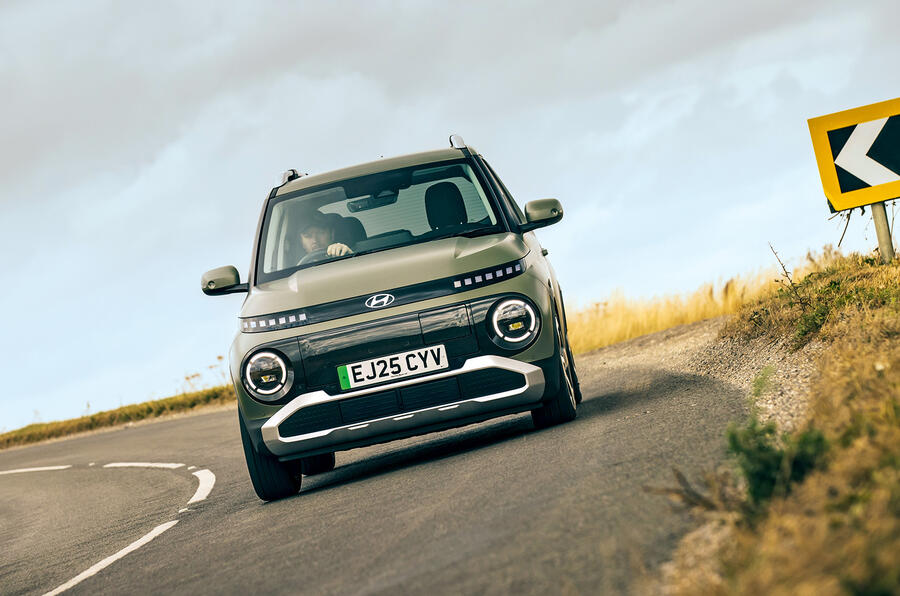
The Inster (which I found a charming thing otherwise) is far from the only offender. Sport, let alone Sport Plus mode (or similar) for the powertrain of any given car, whether electric or combustion-engined, is generally to be avoided, because it tends to map 80% of the power onto the first third of the pedal travel.
Presumably this is done to make the car feel faster than it is initially, at least. Given how many manufacturers are guilty of such tricks, there must be some research somewhere that says customers love it.
Heck, even the Ferrari 12Cilindri gets jumpier as you dial up the spicier modes. Wanting a rear-driven, 819bhp, 0-62-mph-in-2.9 sec car to feel faster than it is seems psychopathic to me, but there we go.
I try to drive smoothly even when I’m alone in the car. It’s so refreshing to drive an old BMW M car or a current Ford Mustang and find a loooong-travel accelerator that is 100% functional. I’ve never driven a TVR, but I’m told they effectively used long throttle pedals as DIY traction control, which may be taking things in a slightly sinister direction.
Where accelerator linearity is sometimes a setting in a menu that the driver can adjust, steering tends to be baked in, and it’s remarkable how many ordinary cars have excessively darty steering off-centre. Renaults are particularly bad for this. The 5, Scenic and Megane all have steering that isn’t unusually quick overall 2.5 turns or so between locks but makes flowing smoothly down a B-road needlessly difficult.
View all car reviews
I can see the purpose of variable-ratio steering that gets quicker as you turn the wheel, because this makes it calm around the dead-ahead but requires less wheel-twirling when parking. But what’s happening on Renaults, and indeed quite a few Audis and BMWs, is surely the opposite of how it should be done.
There are cars that show there’s no need for this superficial hyperactivity. The new Honda Prelude‘s steering is just two turns lock to lock, yet it’s progressive and full of feel – some of the best steering I’ve experienced in a mainstream new car.
Presumably all of this is done so that cars instantly feel ‘sporty’ to prospective customers taking a test drive around a suburban block. The ludicrous power outputs of some EVs fit into this picture: you try it once and scare yourself silly, then just use it for bragging rights.
If this is what’s needed to sell cars today, I won’t say it’s wrong. But I am convinced that there’s a better way. When you drive a car with carefully tuned controls (the Mercedes-Benz CLA EQ, Skoda Superb diesel and Volvo EX90 spring to mind), it just feels right; it feels relaxing. It can be hard to put your finger on why, but the effect is unmistakable.
Can’t we all use a bit of calm in our lives? It must be possible to make that into just as much of a selling point as 0-62mph in 3.0sec.
Join our WhatsApp community and be the first to read about the latest news and reviews wowing the car world. Our community is the best, easiest and most direct place to tap into the minds of Autocar, and if you join you’ll also be treated to unique WhatsApp content. You can leave at any time after joining – check our full privacy policy here.
As a road tester, Illya drives everything from superminis to supercars, and writes reviews and comparison tests, while also managing the magazine’s Drives section. Much of his time is spent wrangling the data logger and wielding the tape measure to gather the data for Autocar’s in-depth instrumented road tests.
He loves cars that are fun and usable on the road – whether piston-powered or electric – or just cars that are very fit for purpose. When not in test cars, he drives an R53-generation Mini Cooper S or a 1990 BMW 325i Touring.
There seems to be an assumption that the lock-to-lock number of turns of a wheel gives you a direct comparison from one car to another.
However, this assumes that all cars achieve the same final angle of turn of the wheels, which I doubt to be the case. Different sized wheel packages and the proximity of structural members can make quite a difference to max allowable wheel rotation.
So two turns lock-to-lock on one car may be actually quite different gearing to that on another
Modern cars really are too sensitive with all the beeping. It’s ironic that I find more peace playing simple browser games like Cookie Clicker 2 (cookieclicker2.top) or just messing around in Hytale concepts than actually driving my ‘smart’ car sometimes.
This is why today’s cars, to me, are much less appealing than those of a few years ago. Even leaving aside the physical controls replaced by touchscreens (dangerous and distracting: you can’t even develop muscle memory because you have to watch where you put your fingers) and intrusive ADAS (the first thing you do before driving is deactivate them), today’s cars are generally lumps with poor driving dynamics somehow masked by electronic controls. The remedy for the boredom these vehicles would otherwise inspire is this: calibration tricks like those described in the article, bells and whistles of infotainment and ambient lighting amidst piano black finishes, the exterior of the car made more dramatic by vaguely aggressive shapes with profuse fake air vents and sometimes – especially on german premium cars – fake tailpipes. As carmakers try to cut costs, I think the fact that always-connected vehicles communicate all their usage data has something to do with it: carmakers today know that refined vehicle dynamics get never actually exploited by car drivers. Therefore, frills and calibration gimmicks are more than enough as selling points. How sad.
I don’t like this connected thing either, it’s counterproductive,causes more problems,I don’t need a beep every time I enter and exit a speed zone, I can read roadside warning signs,ok, you can turn off the beep sound so who thought it was needed and why in the first place?, all this tech implies is we are all bad drivers,well,yes, maybe some of us for various reasons shouldn’t be driving, the new over 70 rule coming is hopefully going to weed out the I’m still a competent driver brigade,no, filling a car with aids and apps you rarely if ever use and your paying for them.
As for driving aids in my car, yes they are mostly off (lane keeping only works well on Mways) but with the proliferation of 20 limits and the real threat of fines at 23 mph and above, I find the speed limiter function invaluable in urban areas . Really though, going more than 10% over the limit almost anywhere now and you risk a hefty fine, which makes me wonder where all this enthusiastic driving that modern detached cars are so bad at, is being done.
View all car reviews
Related Article